
West Palm Beach
24-Hour Towing in West Palm Beach
Car overheating in West Palm Beach traffic? Learn the safest steps to take, what not to do, and when to request 24-hour towing or a flatbed.
Availability and pricing are confirmed on the call.
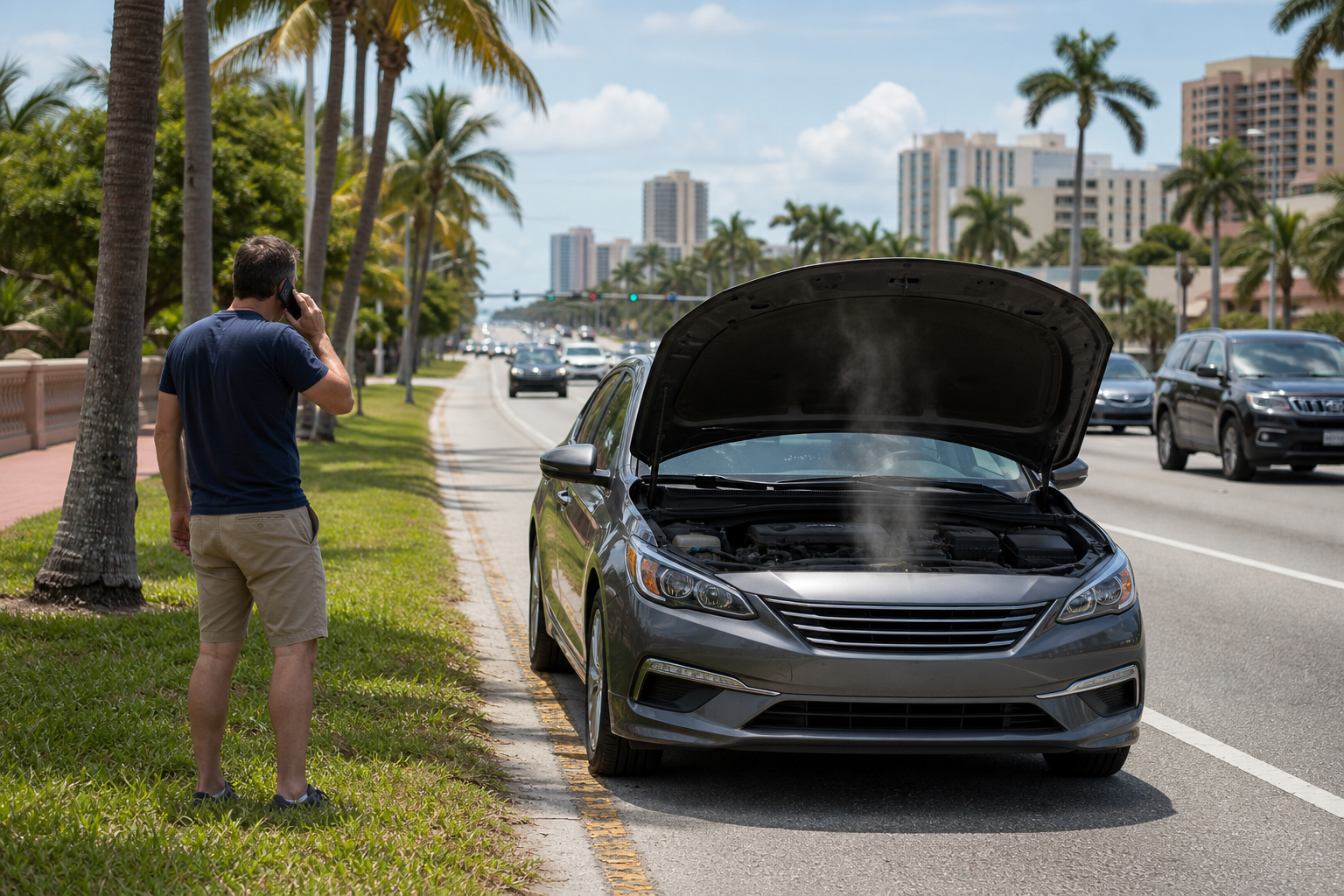
An overheating warning can turn a normal drive into an urgent problem quickly, especially during hot, slow-moving traffic in West Palm Beach. If the temperature gauge climbs into the red, a temperature warning light appears, or steam begins coming from under the hood, the priority is simple: get out of traffic safely and stop driving before engine damage gets worse.
Whether you are creeping along I-95, waiting through lights on Okeechobee Boulevard, or caught in afternoon traffic near downtown, do not try to “push through” an overheating event. A short delay to get help is usually safer than continuing with an engine that cannot stay cool.
If Your Temperature Gauge Is Rising: Do This Now
- Turn off the air conditioning. This reduces demand on the engine.
- Turn the heater to high only while you are still moving to a safe place. It can draw some heat away from the engine, but it is not a fix.
- Pull over as soon as it is safe. Use your signals, hazards, and a safe shoulder, parking lot, or side street when available.
- Turn the engine off. Do not keep idling to see if the gauge improves.
- Stay clear of the hood until everything cools. Never remove a radiator or coolant cap from a hot engine.
Recognize the Difference Between Warm and Overheating
Florida heat can make a vehicle run warmer than it does on a mild day, but an actual overheating problem needs attention. Watch for a temperature needle moving beyond its normal range, a dashboard temperature warning, a sweet or burning smell, reduced power, steam, or fluid dripping beneath the front of the vehicle.
Steam is especially important. It may look like harmless vapor, but it can indicate very hot coolant escaping under pressure. Keep your face and hands away from the hood area. Do not attempt to inspect the radiator, open a coolant reservoir, or add water while the engine is hot.
Get to a Safer Stopping Point Without Making the Problem Worse
If you have enough time and the vehicle is still responding normally, move deliberately toward the nearest safe place to stop. Avoid abrupt lane changes. On busy roads, use your hazard lights and focus on reaching a location where you can be well away from moving vehicles.
A parking lot is preferable to a narrow roadside shoulder. If you are on a major corridor such as I-95 or near an active interchange, do not remain in the vehicle if it is unsafe or positioned close to traffic. Move to a protected area when possible, but only if you can do so without crossing active lanes or placing yourself in danger.
Once stopped, shift into park, apply the parking brake, turn off the engine, and let the vehicle cool naturally. Opening the hood only after the engine has cooled can help release heat, but do not do this if steam is still escaping or if opening the hood would place you near traffic.
What Not to Do When a Car Overheats
- Do not keep driving to your destination. Continuing even a few more miles can turn a cooling-system issue into serious engine damage.
- Do not pour cold water over a hot engine. Rapid temperature changes can damage hot components.
- Do not open the radiator cap or coolant cap while hot. Pressurized coolant can spray out and cause severe burns.
- Do not assume the problem is solved because the gauge drops. A warning that comes and goes may still point to a leak, fan issue, coolant problem, or another fault.
- Do not sit in an unsafe location waiting for the engine to cool. If traffic is close, visibility is poor, or the shoulder is narrow, towing may be the safer choice.
After the Engine Has Cooled
Give the vehicle time to cool completely. Cooling can take longer in direct sun or during humid Florida weather. When there is no steam and the engine compartment is no longer extremely hot, you may visually look for obvious signs such as a puddle under the vehicle, a loose hose, or coolant residue. Do not touch hot parts or attempt a roadside repair you are not comfortable making.
If your owner’s manual provides instructions for checking coolant, follow those instructions exactly. A low coolant level can be a clue, but adding fluid does not necessarily make the car safe to drive. Coolant may have escaped because of a leak, a failed hose, a faulty fan, or another issue that can cause the vehicle to overheat again almost immediately.
If the temperature warning appeared while you were driving, the most cautious decision is generally to arrange transportation rather than restart and continue through West Palm Beach traffic. Flatbed towing is a practical option when you want to keep an overheating vehicle off the road and avoid adding engine stress.
When Towing Is the Right Next Step
Call for towing or roadside assistance if any of the following applies:
- The temperature gauge reached the red zone or a temperature warning stayed on.
- There is steam, a visible coolant leak, or a strong sweet smell from the engine area.
- The vehicle lost power, ran roughly, shut off, or will not restart normally.
- The car overheated more than once during the same trip.
- You are stopped in an exposed location, such as a busy shoulder or a high-traffic road.
- You are unsure whether the vehicle can be driven without overheating again.
For a car that is disabled after hours or in an unsafe location, 24-hour towing assistance can help you move the vehicle rather than risk a second overheating event. If the situation is urgent because you are stranded in traffic or cannot safely remain where you are, use emergency towing to request help.
Information to Have Ready When You Call
A clear location helps a tow operator find you efficiently. Before calling, note the road name, nearby cross street, direction of travel, landmark, and your vehicle’s color, make, and model. If you are on I-95, identify whether you are northbound or southbound and the nearest exit or visible mile marker. If you are in a parking lot, provide the business name and the section of the lot where you are parked.
Also mention that the vehicle overheated, whether steam or a leak is visible, and whether it can roll and steer. This helps determine the safest loading approach. Keep your phone charged if possible, turn on hazard lights when appropriate, and remain aware of surrounding traffic while you wait.
Quick Overheating Checklist
- Turn off the A/C.
- Use the heater briefly only to help reach a safe stopping place.
- Signal, use hazards, and pull over safely.
- Turn off the engine.
- Do not open a hot radiator or coolant cap.
- Do not drive again if the warning was severe, steam appeared, or coolant is leaking.
- Share your exact location and vehicle details when requesting help.
Frequently Asked Questions
Can I drive a short distance after my car overheats?
It is not a good idea. If the vehicle has overheated, driving farther can cause additional engine damage or leave you stranded in a worse location. Pull over safely and arrange help if there is any doubt about whether the cooling system is functioning correctly.
Should I add water to an overheating car?
Never add water or coolant to a hot, pressurized system. After the engine is fully cool, consult the owner’s manual before checking fluid levels. Even if the level is low, the underlying reason for the loss should be addressed before normal driving resumes.
Why does my car overheat more often in Florida traffic?
High outdoor temperatures, humidity, direct sun, and stop-and-go traffic reduce the cooling relief a vehicle gets from steady airflow. Those conditions can expose an existing cooling-system problem, especially when the vehicle is idling for long periods.
Is steam from under the hood always an emergency?
Steam should be treated seriously because it may be hot coolant escaping from the cooling system. Pull over safely, shut off the engine, and keep clear of the engine compartment until it has cooled. Towing is often the safest option when steam is present.
Can a flatbed tow an overheating vehicle?
Yes. A flatbed keeps the vehicle fully off the road during transport, which can be useful when the engine has overheated and you do not want to risk driving it farther. Request flatbed towing if you need to move an overheating vehicle to a safe destination.
Let’s talk through it
Where do you
need to go?
Call with your location and vehicle details.