
West Palm Beach
24-Hour Towing in West Palm Beach
Car overheating in West Palm Beach traffic? Learn what to do immediately, where to stop safely, what not to touch, and when to call for emergency towing.
Availability and pricing are confirmed on the call.
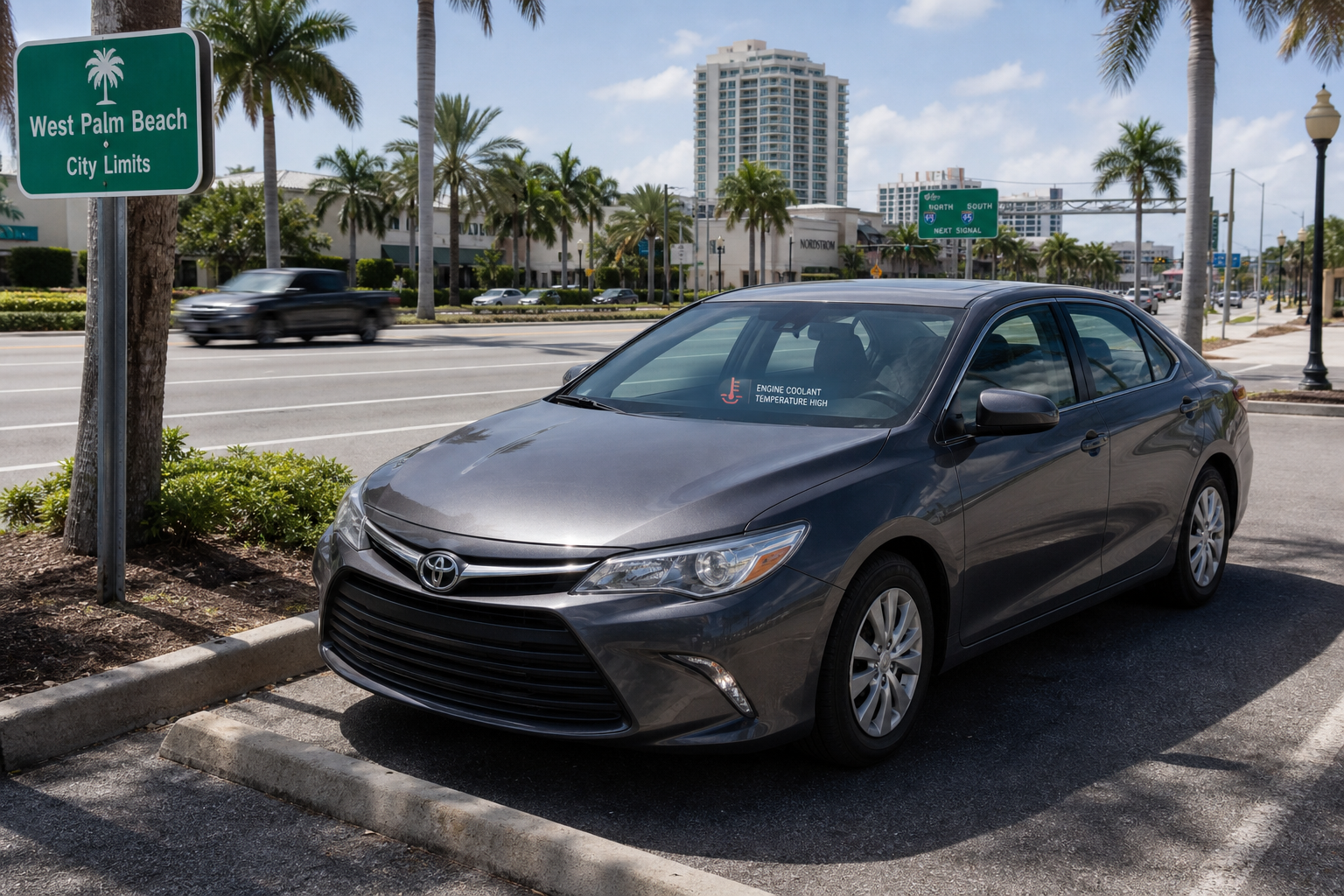
An overheating warning can become urgent quickly, especially when traffic is slow and airflow through the radiator is limited. If your temperature gauge is climbing, a temperature warning light appears, or steam is coming from under the hood, the goal is not to make it home or reach a repair shop. The goal is to get yourself and your vehicle out of active traffic without causing engine damage or creating a roadside hazard.
Immediate Actions: Protect Yourself and the Engine
- Turn off the air conditioner. This reduces load on the engine.
- Watch for a safe place to stop immediately. Use a parking lot, service road, or other off-road location if one is safely reachable.
- If you are still moving and need a brief measure to reach a safe stopping point, turn the heater on high. It may draw some heat away from the engine, but it is not a solution for continuing to drive with an overheating warning.
- Pull over, shift into park, and turn the engine off.
- Do not open the radiator cap or coolant reservoir cap while the engine is hot. Pressurized hot coolant can cause serious burns.
- Arrange help if the warning remains on, steam is present, or the vehicle cannot be safely driven.
First Priority: Get Out of the Traffic Stream
West Palm Beach drivers can encounter long stretches of slow-moving traffic on I-95, Okeechobee Boulevard, Southern Boulevard, Palm Beach Lakes Boulevard, and U.S. 1. Stop-and-go driving is especially hard on a cooling system because the vehicle may not receive enough airflow through the radiator while it sits at low speed.
Where you stop matters. If you are on a surface street and a nearby parking lot or side access area is immediately available before the temperature reaches the danger zone, carefully move there. Do not make risky turns, cross multiple lanes, or continue several miles in hopes of finding a better location. If the warning is severe, steam is visible, or the gauge is already in the red, stop at the first reasonably safe location.
On a high-speed roadway such as I-95, signal early, move as far right as conditions allow, and stop as far from moving traffic as possible. Do not try to drive to the next exit once the engine is actively overheating. If your location creates an immediate safety concern, contact emergency services first. Once you are in a safer position, request emergency towing assistance rather than risking a damaged engine.
How to Tell Whether It Is a True Overheating Emergency
A rising temperature gauge should always be taken seriously, but some signs mean you should stop driving right away:
- The temperature gauge reaches the red zone or a temperature warning appears.
- Steam, vapor, or a sweet-smelling mist is coming from under the hood.
- You see coolant dripping or pooling beneath the vehicle.
- The cabin heater suddenly blows cold air while the temperature gauge rises.
- The engine loses power, runs roughly, or an alert tells you to stop the vehicle.
- The warning returns after the vehicle has cooled down.
Florida heat can make an existing cooling-system problem show up sooner, but heat alone is not usually the mechanical cause. Overheating commonly involves low coolant, a coolant leak, a failed radiator fan, restricted airflow, a damaged hose, thermostat trouble, water-pump issues, or another cooling-system fault. You do not need to diagnose the cause at the roadside. Your job is to avoid turning a manageable problem into major engine damage.
Once You Are Stopped: What to Do and What to Avoid
Do this
- Turn the engine off and set the parking brake.
- Turn on hazard lights, particularly if you are near moving traffic.
- Move passengers to a safer location away from traffic when it is safe to do so.
- Allow the vehicle to cool completely before looking under the hood.
- Use your phone to note your location, nearby cross streets, direction of travel, and visible landmarks for the tow provider.
Do not do this
- Do not remove a hot radiator cap or coolant cap.
- Do not pour cold water over a hot engine or radiator.
- Do not keep restarting the vehicle to see whether the warning disappears.
- Do not assume the issue is solved because the gauge drops after the engine rests.
- Do not drive with steam coming from the engine bay.
After the engine has fully cooled, you may be able to identify an obvious puddle or a loose-looking hose, but avoid touching hot parts or attempting roadside repairs in traffic. A visual check does not make it safe to drive again. If coolant was low enough to trigger overheating, there may be a leak or another fault that needs proper attention.
When Towing Is the Smart Choice
Arrange a tow when there is any doubt about whether the vehicle can be driven safely. A short tow is often a far better outcome than continuing with an overheated engine and risking severe internal damage.
Call for towing when:
- The temperature warning light is on or the gauge entered the red zone.
- Steam, coolant odor, or visible leaking is present.
- The vehicle overheated while idling in traffic and you do not know why.
- The cooling fan does not appear to be operating when the engine is hot.
- The vehicle has overheated more than once.
- You are stopped in an unsafe area and need the vehicle removed promptly.
- You cannot confidently make even a short drive without the warning returning.
For a vehicle that should not be driven, request 24-hour towing and share your exact location, vehicle type, destination, and whether the car is on a shoulder, in a parking lot, or blocked in traffic. If clearance or vehicle condition makes loading a concern, a flatbed tow can keep all four wheels off the road during transport.
Helpful Information to Have Ready When You Call
Clear details help the towing process go more smoothly, particularly in busy areas around downtown West Palm Beach or along major corridors where access can be limited. Before calling, gather what you safely can:
- Your exact location: street name, nearest cross street, business name, exit number, or direction of travel.
- Your vehicle's year, make, model, and color.
- Whether the vehicle is in a parking space, driveway, shoulder, garage, or active roadway.
- Whether the engine is off and whether steam or fluid is visible.
- Your preferred destination, such as home or a repair facility.
- Any access issues, including a locked garage, low-clearance area, or blocked wheels.
If you are waiting near a roadway, remain aware of traffic. Do not stand between your vehicle and passing cars, and do not wait directly in front of or behind the vehicle.
A Simple Overheating Decision Checklist
- Gauge rising but no warning yet: Turn off A/C, look for the nearest safe place to stop, and monitor the gauge closely.
- Warning light, red gauge, or steam: Stop as soon as safely possible and turn the engine off.
- Vehicle cools down: Do not assume it is repaired; inspect only after cooling and arrange towing if the cause is unknown.
- Stuck in a traffic lane or dangerous shoulder: Prioritize personal safety and seek emergency assistance if necessary.
- Unsure whether to drive: Choose towing. An overheating engine is not a problem to test on a busy West Palm Beach road.
Frequently Asked Questions
Can I drive a short distance after my car overheats?
It is best not to. If the temperature warning light appears, the gauge enters the red zone, or steam is visible, stop as soon as safely possible. Driving even a short distance can worsen engine damage.
Should I add water to an overheated car?
Never add water or coolant by opening a hot radiator or coolant cap. Wait until the engine is fully cool. Even then, adding fluid may not solve the reason the vehicle overheated, especially if there is a leak or cooling-system failure.
Why did my car overheat while sitting in West Palm Beach traffic?
Idling and slow traffic reduce airflow through the radiator. A healthy cooling system should still manage normal traffic, so overheating in those conditions can point to low coolant, a fan problem, a leak, or another cooling-system issue.
Can turning on the heater prevent engine damage?
Turning the heater on high may provide a small amount of temporary heat relief while you move to an immediately available safe stopping place. It should not be used to keep driving after a temperature warning, red gauge reading, or visible steam.
Should I request a flatbed for an overheated vehicle?
A flatbed is often a practical option when the vehicle should not be driven or when you want it fully carried to its destination. Explain that the vehicle overheated when requesting flatbed towing so the towing provider can prepare appropriately.
Let’s talk through it
Where do you
need to go?
Call with your location and vehicle details.