
West Palm Beach
24-Hour Towing in West Palm Beach
Learn what happens after you request a tow in West Palm Beach, from securing your vehicle and reporting the problem to choosing the right towing help.
Availability and pricing are confirmed on the call.
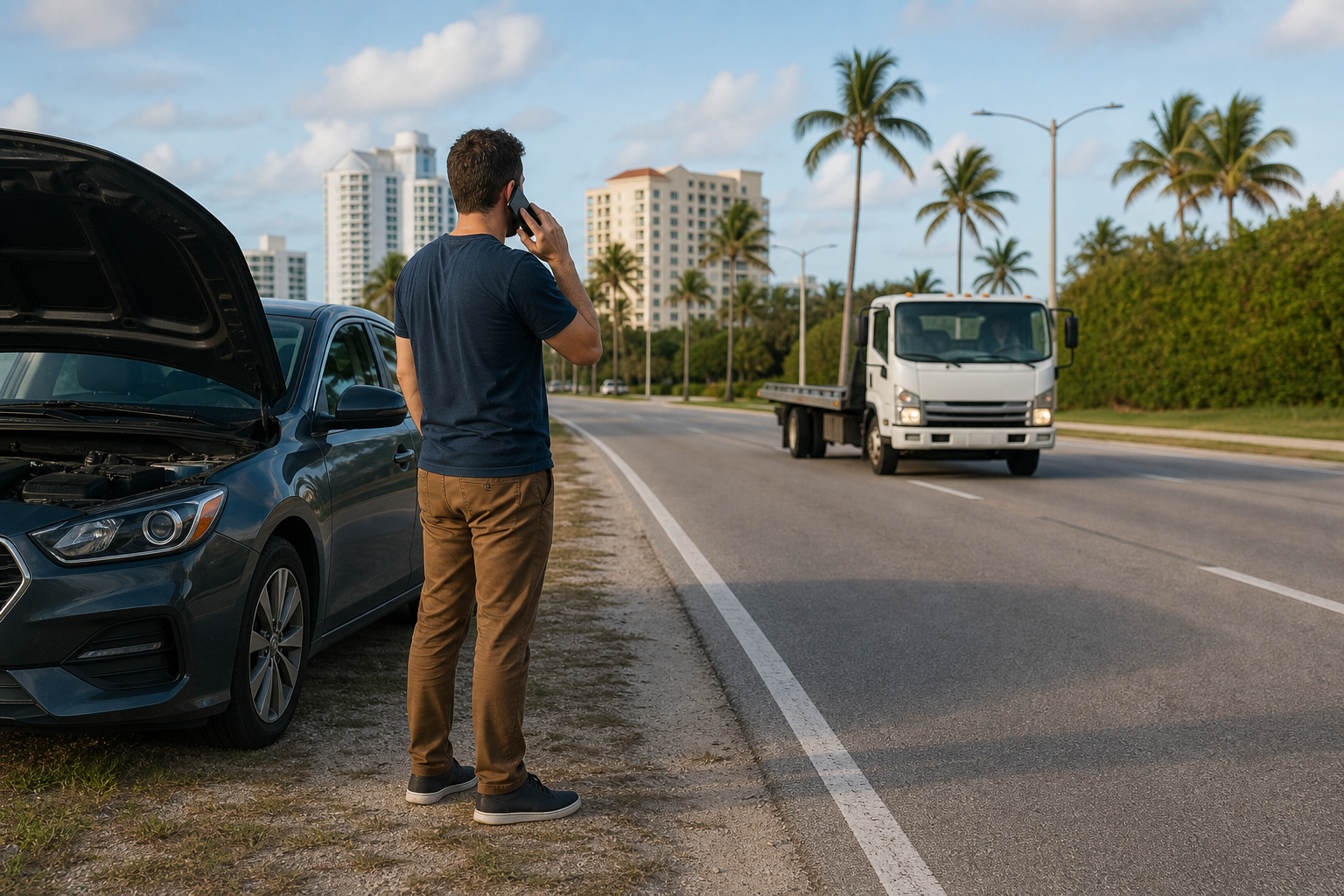
Your vehicle has stopped moving, started making a sound that does not belong, or shown a warning that makes driving feel like a gamble. Before trying another restart or deciding to limp it somewhere, create a safer pause. A tow request is not just a truck being sent out; it is a short handoff of information that helps match your vehicle’s condition, location, and destination with the right kind of help.
Do these things first
- Move out of active traffic only if the vehicle can be moved safely.
- Turn on hazard flashers if they work.
- Keep people away from moving traffic and avoid standing between vehicles.
- Look for a clear location reference before calling: address, business name, parking area, cross street, or map pin.
- Do not keep driving solely to avoid requesting help if the vehicle feels unsafe or may be worsening.
The first 10 minutes: stabilize the situation before solving it
The first few minutes are about safety and clarity, not diagnosis. If your vehicle is in a reasonably safe place, take a moment to notice what changed. Did it fail to start? Did a tire lose air? Is there visible damage? Is a warning light on? Did the steering, brakes, shifting, or engine behavior change? Those details can help determine whether towing is the sensible next step.
If you are stopped in a spot where remaining in or near the vehicle feels exposed to traffic, prioritize getting to a safer position if possible. Do not attempt a complicated repair at the roadside. Do not crawl beneath the vehicle. If there is smoke, a burning smell, leaking fluid, or a condition that makes the vehicle seem unsafe to operate, stop trying to drive it and report that clearly when you request help.
In West Palm Beach, the tow-versus-drive decision should be based on the vehicle’s current condition, not on how close the destination seems. A short drive with a serious mechanical, tire, steering, braking, or overheating concern can turn a manageable towing need into more vehicle damage. If you cannot confidently say the vehicle is safe to control and operate, arrange towing.
Decision points: tow it, move it carefully, or ask for guidance
A towing request becomes easier when you know what decision you are making. You do not need to identify the exact failure. You do need to describe what you can see and feel.
Request towing now when the vehicle should not be driven
- The vehicle will not start or will not remain running.
- A wheel, tire, body panel, or underside appears damaged enough to affect safe movement.
- Steering, braking, acceleration, shifting, or handling has changed in a way that feels unreliable.
- The engine is overheating, smoking, leaking, or producing a strong burning odor.
- The vehicle was involved in an incident and you are unsure whether it can be driven safely.
- The vehicle is stuck, blocked in, or positioned where moving it without proper equipment could cause damage.
For an urgent situation that needs a vehicle moved safely, use emergency towing assistance. If your vehicle has low clearance, significant damage, all-wheel drive, or a condition where keeping all tires off the ground is preferable, ask about flatbed towing.
Consider a careful move only when the vehicle is clearly controllable
If the vehicle starts, steers, brakes, and handles normally and there is no sign of overheating, leaking, tire damage, or body interference, you may be able to move it to a safer nearby position. That is different from deciding it is safe to continue a trip. If doubt remains, stop and request a tow rather than testing the vehicle repeatedly.
If you are unsure, describe the condition instead of guessing
You do not need to decide what equipment is required on your own. Say what happened, what the vehicle is doing now, and what you observed. “The car starts but will not shift normally” is more useful than naming a mechanical problem you cannot confirm. Clear facts help the towing provider prepare for the job.
What to report when you request help
A good tow request gives the dispatcher enough information to locate you, identify the vehicle, and understand any handling concerns. Keep your phone available after the call in case the provider needs to confirm a detail.
Your tow-request checklist
- Exact location: A street address, nearby business, parking lot section, cross street, or map pin. Mention which side of a divided street or entrance you are near if that helps identify your position.
- Vehicle basics: Year, make, model, color, and license plate if requested.
- Vehicle condition: Non-starting, flat tire, overheating, accident-related damage, stuck, locked out, or another visible issue.
- Drivability: Say if the vehicle rolls, steers, shifts into neutral, has a locked wheel, has a damaged tire, or cannot be moved.
- Occupants and access: Let the provider know if anyone is waiting with the vehicle and if the keys are available.
- Destination: Provide the full address or a clear destination name before dispatch when possible.
- Special access details: Share gate codes, garage height limitations, parking instructions, or any obstacle that could affect access to the vehicle.
It also helps to remove valuables, gather medications or essential personal items, and take a few photos of the vehicle’s visible condition before loading if doing so is safe. Keep the keys accessible unless the towing provider gives you a different instruction.
What the towing provider does next
After receiving your request, the provider reviews the location, vehicle type, reported condition, and destination. That information helps determine the appropriate towing approach. A standard tow may fit some situations, while a flatbed may be the better match for a vehicle that cannot roll normally, has low clearance, has damage, or should be transported with its tires off the road.
Before loading, the tow operator will assess the vehicle’s position and condition on arrival. They may need to confirm that the vehicle can be accessed, placed in the proper gear or neutral position, or safely secured. If your vehicle cannot roll or has a locked steering system, tell the provider before arrival so the situation is not a surprise.
Once the vehicle is secured, it is transported to the destination you provided. If your plans change, communicate that as early as possible. Changes in destination, vehicle access, or condition can affect how the tow is handled.
For a vehicle that needs to be moved outside normal business hours or when you are stranded and need assistance promptly, 24-hour towing service is the appropriate starting point. The most useful call is a calm, factual one: where you are, what vehicle you have, what it is doing, and where it needs to go.
Questions drivers often ask before a tow arrives
Should I try to restart the vehicle before calling?
One reasonable attempt may be enough if there is no smoke, burning smell, leaking fluid, or other sign of danger. Repeated attempts can drain the battery or worsen an underlying issue. If it does not start normally, report that it is non-starting.
Do I need to know what is wrong with my car?
No. Describe symptoms rather than trying to diagnose the cause. Tell the provider what you saw, heard, smelled, or felt and whether the vehicle can roll, steer, or shift.
Can I leave the vehicle before the tow truck arrives?
Ask the towing provider about their process first. Vehicle access, keys, destination details, and authorization may need to be arranged before the tow can be completed.
What if my vehicle is in a parking garage or tight parking area?
Tell the provider during the request. Include the garage level, clearance concerns, gate or access details, and whether the vehicle is blocked by other cars. That information helps determine the safest approach.
Is a flatbed always necessary?
Not always. The right method depends on the vehicle and its condition. Explain any damage, low clearance, locked wheels, or inability to roll so the towing provider can determine the appropriate equipment.
A calm handoff when driving is no longer the right call
If the vehicle is not safe to drive, stop trying to make it work at the roadside. Gather your location and vehicle details, request the level of towing help that fits the situation, and stay reachable for follow-up. Request towing help with a clear description of the vehicle’s condition, and let the next step be a controlled transport rather than a risky drive.
Let’s talk through it
Where do you
need to go?
Call with your location and vehicle details.