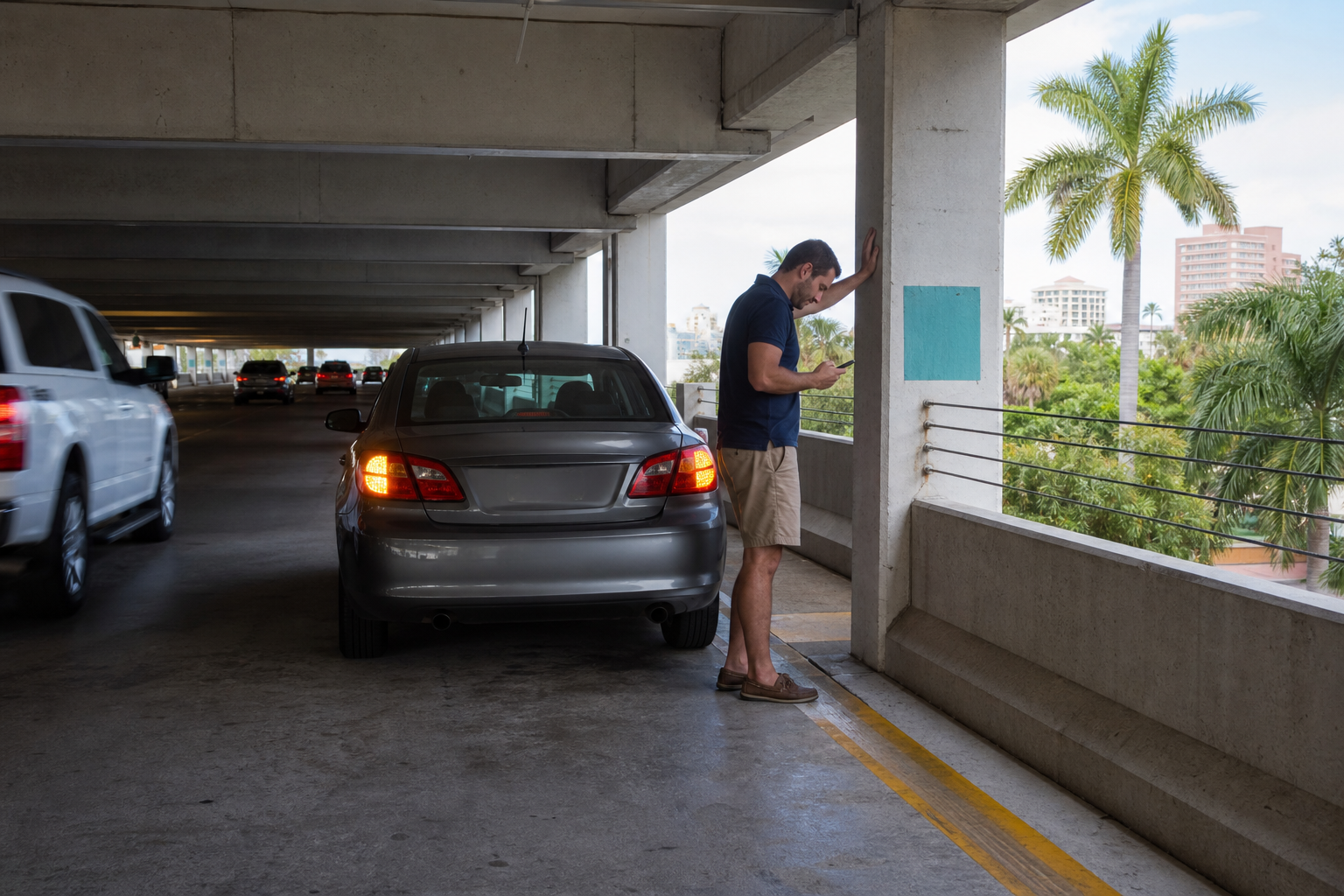
Your vehicle will not restart, cars are moving past, and the location pin on your phone only identifies a large airport or an entire parking structure. Before requesting a tow, pause long enough to gather the details that tell the dispatcher where the vehicle actually is—and what kind of equipment can reach it.
Quick answer: report the access point, not just the property
For vehicle trouble near an airport or parking garage in West Palm Beach, provide the property name shown on signs, your exact level or roadway position, the nearest entrance or exit, any section or pillar identifier, posted height clearance, and whether the vehicle can roll, steer, and shift into neutral. Also describe traffic exposure: say if the car is blocking a lane, sitting around a blind turn, or safely inside a marked space.
Do this now
- Turn on the hazard lights.
- Move yourself away from active vehicle paths if you can do so safely.
- Photograph nearby level, section, entrance, and clearance signs.
- Call from a place where you can hear the dispatcher without losing sight of the vehicle.
If the vehicle is exposed to moving traffic, will not move, or cannot be reached with ordinary roadside equipment, request emergency towing help and describe the exposure first.
What to report—and what leaves the tow operator guessing
| Do report | Do not rely on |
|---|---|
| The exact airport roadway area, garage name, or parking facility name visible to you | “I’m at the airport” or “I’m in a garage” |
| Level, row, section, pillar marker, or nearest elevator or stair identifier | A phone location pin by itself, especially inside a concrete structure |
| The entrance you used and the closest usable vehicle entrance | Assuming every entrance leads to the same level |
| Posted height clearance and any low pipes, ramps, tight turns, gates, or overhead barriers | Guessing that a tow truck can follow the route taken by a passenger car |
| Whether the car rolls, steers, brakes, starts, and shifts into neutral | Only saying that the car is “dead” |
| Whether the vehicle is in a space, travel lane, ramp, pickup area, or near a blind corner | Waiting until dispatch asks about traffic exposure |
| Vehicle year, make, model, drive type if known, and visible damage | Choosing towing equipment based only on the vehicle’s size |
Step-by-step: build a location description a tow operator can use
1. Deal with visibility before making the call
Airport approaches and garage lanes can place a disabled vehicle close to turning, merging, or distracted traffic. Activate the hazards. If the car is in a marked space and there is no smoke, fire, or other immediate danger, leaving it in place may be safer than pushing it into a travel lane. Do not stand behind the vehicle, around a blind garage turn, or between the car and moving traffic.
If visibility is poor, tell dispatch immediately. Use direct language such as: “The vehicle is stopped in an active lane after a turn, and approaching drivers may not see it early.” That detail can affect how the call is prepared.
2. Read the location from fixed signs
Look for information attached to the property rather than depending solely on a map app. Useful references include the facility name, parking level, color or letter zone, row, pillar marker, entrance name, elevator bank, or stair identifier. Report only what is visibly posted; do not guess.
For an airport-area roadway, state whether you are in a pickup lane, drop-off lane, parking entrance, garage approach, or another signed area. Add your direction of travel and the nearest sign you can read. For a garage, a useful description might be: “Level 3, section C, two rows from the east vehicle ramp.”
3. Trace the route a tow vehicle would need to take
Think backward from the disabled car to the street entrance. Which driveway did you use? Did you pass through a gate? Are there separate up and down ramps? Is the vehicle behind a ticket arm or access-controlled door? A dispatcher may need an alternate meeting point or instructions for gaining entry.
Do not promise that an entrance is suitable for towing equipment. Instead, report what you see. Photos of the entrance, overhead clearance sign, turns, ramp slope, and space around the car can help the towing provider evaluate access.
4. Check clearance without estimating
Height is one of the most useful garage details because towing vehicles and loaded configurations need more room than a passenger car. Find the posted clearance at the entrance and note any lower overhead pipes or signs along the route. If you cannot safely inspect the entrance, say that the clearance is unknown.
A flatbed tow truck may be appropriate for many vehicle conditions, but a low garage can limit where it can operate. The towing provider may need to plan a different recovery method or determine whether the vehicle can be moved to an accessible loading point. Do not push, tow, or roll the car without instructions if steering or braking is compromised.
5. Describe what the vehicle can and cannot do
Give a short functional report:
- Does the engine start or crank?
- Can the transmission shift into neutral?
- Can the steering wheel turn?
- Does the brake pedal respond normally?
- Are any wheels flat, locked, bent, or visibly out of position?
- Is the parking brake stuck?
- Is there leaking fluid, smoke, or collision damage?
- Are the keys present?
Do not crawl beneath the vehicle or touch leaking fluid. These answers help determine whether the car can be rolled, winched, or loaded and whether confined-space access creates an additional problem.
6. Confirm where you and the vehicle will be
Before ending the call, repeat the location and provide a callback number. Say whether you will remain with the vehicle or wait at a safer nearby point. If you move, send or report the new position; a driver searching the wrong level or entrance loses the benefit of every other detail you supplied.
Keep your phone available and answer calls from the towing provider. If property staff direct you to another pickup location, relay that update before attempting to move the vehicle.
Call checklist
- Property or facility name shown on signs
- Exact roadway area or garage level and section
- Nearest fixed marker, entrance, elevator, or ramp
- Posted height clearance
- Gate, ticket, or access instructions
- Traffic exposure and visibility around the car
- Vehicle year, make, model, and drive type if known
- Whether it rolls, steers, brakes, and shifts into neutral
- Flat, locked, or damaged wheels
- Smoke, leaking fluid, or visible collision damage
- Your safe waiting position and callback number
Airport and parking-garage towing FAQs
Is a phone location pin enough inside a parking garage?
Usually not. A pin may identify the structure without showing the correct floor, section, ramp, or entrance. Send the pin if requested, but pair it with visible level and access details.
What if I cannot find the garage clearance?
Tell dispatch that the clearance is unknown rather than estimating. If safe, photograph the vehicle entrance and overhead area. The towing provider can then decide what additional information is needed.
Should I move the car out of an airport lane or garage ramp?
Move it only if you can do so safely and the vehicle still has dependable steering and braking. Do not push from an exposed position or let a disabled car roll down a ramp. If it cannot be moved safely, report that it is obstructing traffic and request help.
When should I request 24-hour towing instead of waiting?
Call promptly when the vehicle is exposed to traffic, cannot roll or steer, has a locked or damaged wheel, is leaking fluid, or is stranded in a controlled-access area that may complicate retrieval. 24-hour towing service is also the direct choice when the vehicle needs transport rather than a simple restart or tire-related roadside solution.
What if a flatbed cannot enter the garage?
Do not assume the tow cannot be completed. Report the clearance, ramp layout, vehicle condition, and distance to an open loading area. The provider can evaluate the access and explain the next safe step.
Choose the call based on the vehicle’s position
Call now if the car is in an active lane, hard to see, unable to steer or brake, leaking fluid, or trapped behind a clearance or access obstacle. Gather the checklist first if the car is secure in a marked space and you can safely read nearby signs. In either case, lead with the exact location and traffic exposure—not just the name of the airport or garage.