
West Palm Beach
24-Hour Towing in West Palm Beach
Learn what to do when your vehicle breaks down on a busy West Palm Beach road. Get safety steps, towing guidance, a checklist, and answers to common roadside questions.
Availability and pricing are confirmed on the call.
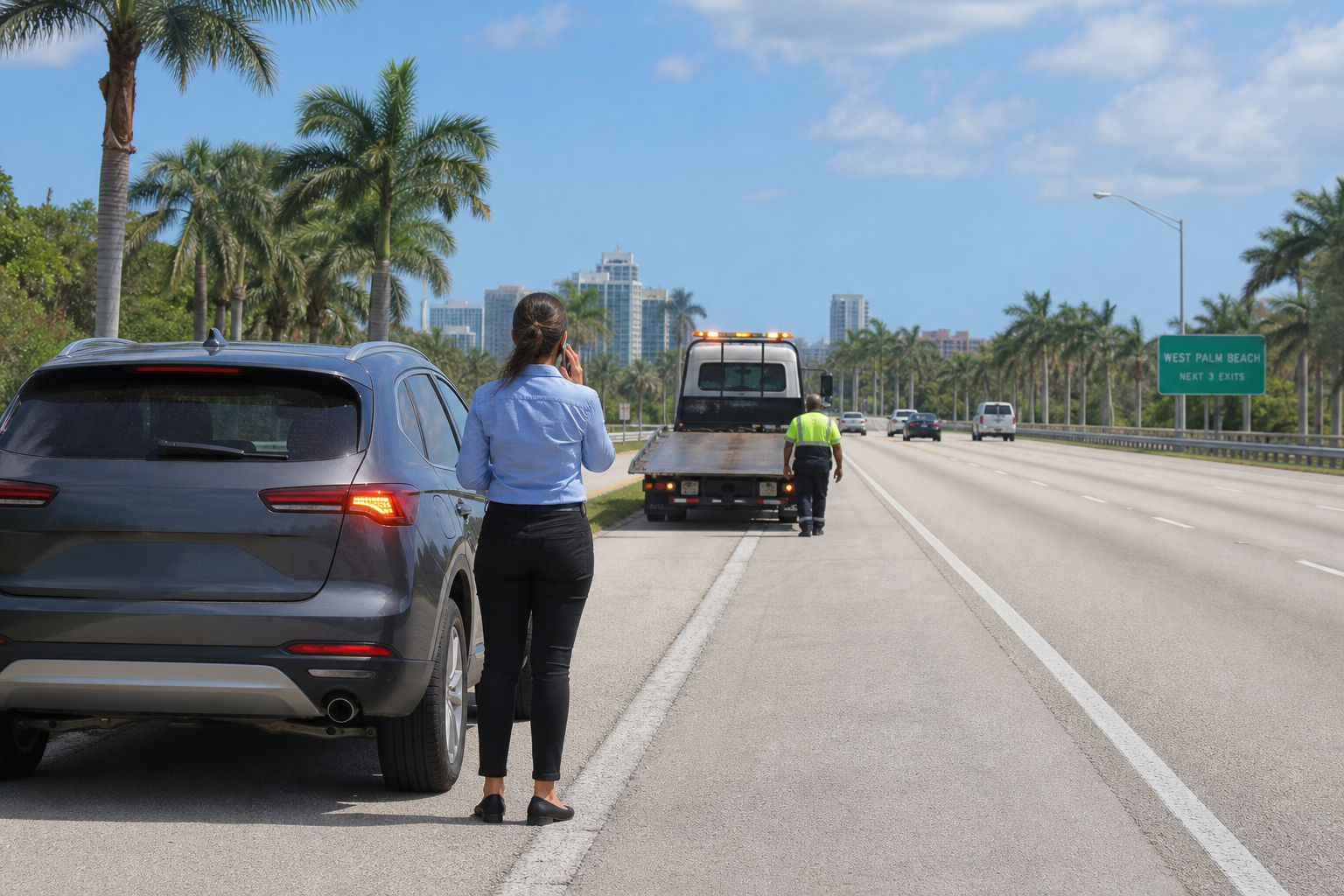
If Your Vehicle Stops on a Busy Road: Do This First
- Turn on your hazard lights immediately.
- Steer to the far-right shoulder, a safe parking area, or an exit if the vehicle can still move.
- Move as far away from moving traffic as possible, but do not stop in an unsafe location just to reach an exit.
- Stay in the vehicle with seat belts fastened when traffic is moving close by and there is no safe place to wait outside.
- Call 911 if there is a crash, injury, fire, smoke, an immediate traffic hazard, or you feel unsafe.
- Arrange 24-hour towing or roadside help once you are in the safest available position.
A breakdown on a busy West Palm Beach road can feel overwhelming, especially when fast traffic is passing within a few feet of your vehicle. The best next step is not always diagnosing the problem. Your first job is to reduce the risk to yourself, your passengers, and other drivers.
Whether you are on I-95, Florida's Turnpike, Okeechobee Boulevard, Southern Boulevard, US-1, or a heavily traveled local connector, the same priorities apply: get visible, get out of the traffic flow when possible, communicate your location clearly, and request the right type of towing assistance.
Get Your Vehicle Out of the Travel Lane If You Can Do It Safely
If the vehicle still rolls, steers, and responds enough to move, use momentum carefully to reach the right shoulder, an emergency stopping area, a parking lot, or the next exit. Turn on the hazard lights as soon as you recognize that the vehicle may not continue normally. Avoid sudden steering or hard braking, particularly in heavy traffic or rain.
On high-speed routes such as I-95 or Florida's Turnpike, stopping in a travel lane creates an immediate hazard. If the vehicle cannot be moved, keep your hazards on and call 911. Follow the instructions of emergency responders or dispatchers before attempting to exit the vehicle or make any additional moves.
On surface roads, do not assume a center turn lane, bus stop, intersection corner, bridge approach, or narrow curb lane is a safe place to wait. Okeechobee Boulevard, Southern Boulevard, and US-1 can have multiple lanes, turning vehicles, and frequent signal changes. A nearby driveway, parking lot, or side street may be safer if you can reach it without taking risks.
Choose the Safest Place to Wait
Your safest waiting location depends on where the vehicle stopped, how close traffic is, road conditions, weather, and whether you have passengers. There is no single answer that fits every breakdown.
When staying inside is usually the better option
Remain inside with seat belts fastened when your vehicle is on or very near a high-speed traffic lane and exiting would place you beside moving vehicles. Keep doors locked if you are waiting in an unfamiliar or isolated area. If possible, sit away from the side nearest traffic.
When getting farther from the vehicle may be necessary
If you smell fuel, see smoke or flames, believe the vehicle could be struck, or are instructed by emergency personnel to move, leave the vehicle carefully and move to a safer area away from traffic. Do not stand directly in front of, behind, or beside a disabled vehicle. Avoid crossing active lanes unless emergency personnel direct you to do so.
In either situation, keep children and passengers together. Do not send someone walking along a busy roadway to look for help. A phone call is generally far safer than trying to flag down passing drivers.
Make Your Location Easy for a Tow Truck to Find
Clear location details can save confusion when you need towing on a busy road. Before calling, look for the most useful identifying information available. This may include a road name, direction of travel, nearest cross street, exit number, landmark, shopping center, or mile marker.
For example, “I am on I-95 southbound near the Okeechobee Boulevard exit” is more useful than simply saying “I am in West Palm Beach.” On a surface street, identify the nearest intersection, such as “on Southern Boulevard near Congress Avenue,” if that is accurate. Your phone map can help confirm your location, but do not spend time interacting with it while the vehicle is moving or while you are exposed to traffic.
- Road name and direction of travel
- Nearest exit, cross street, mile marker, or visible landmark
- Vehicle color, make, model, and license plate if requested
- Whether the vehicle is in a travel lane, shoulder, parking lot, driveway, or garage
- The issue you can observe, such as a flat tire, no-start condition, overheating warning, or vehicle that will not move
- Your destination or preferred safe drop-off location, if known
Do Not Attempt Risky Roadside Fixes
A quick fix can become dangerous when traffic is close, visibility is poor, or weather conditions are changing. Avoid trying to inspect beneath the vehicle, changing a tire near active lanes, pushing the vehicle, or opening the hood beside fast-moving traffic. If you have a flat tire on a busy roadway, a stalled engine, a warning light that prevents safe driving, or a vehicle that cannot be driven normally, calling for help is often the safest choice.
Flatbed transport can be particularly useful when the vehicle should not be driven, has wheel or steering concerns, sits low to the ground, or needs to be moved without adding road miles. If you are uncertain about the safest towing method, describe the situation and request flatbed towing when appropriate.
When to Call for Towing or Emergency Help
Call 911 first for an immediate safety threat: a collision with injuries, fire, smoke, a vehicle blocking live traffic, a disabled vehicle in a dangerous position, or any situation where you cannot safely wait. Emergency responders can help manage urgent roadway hazards and advise you on what to do next.
Call a towing provider when the vehicle is safely positioned or when you need professional transport from the breakdown location. Emergency towing is appropriate when a vehicle cannot be safely driven and needs prompt removal from a roadway, parking area, or other location.
Consider towing instead of trying to continue driving when:
- The vehicle will not start or repeatedly stalls.
- A tire is damaged and changing it would put you too close to traffic.
- The vehicle overheats, loses power, or displays a serious warning.
- Steering, braking, wheel, or suspension behavior feels abnormal.
- You have been involved in a collision and are unsure whether the vehicle is safe to operate.
- The vehicle is stopped on a busy road, ramp, shoulder, or area with limited visibility.
- You are stranded after dark, during heavy rain, or in a location where waiting feels unsafe.
A Practical Breakdown Checklist for West Palm Beach Drivers
- Make yourself visible: hazards on; use interior lights only if they help you safely locate needed items.
- Prioritize positioning: move right and away from active lanes if the vehicle can be moved safely.
- Assess the immediate danger: call 911 for fire, injury, smoke, traffic exposure, or an unsafe stopping location.
- Protect passengers: keep everyone together and away from moving traffic.
- Share an exact location: road, direction, nearby exit or cross street, and visible landmark.
- Request the right help: use 24-hour towing service when the vehicle needs transport outside normal business hours or whenever you are stranded.
- Prepare for pickup: have your destination, vehicle details, and contact number ready.
- Wait safely: keep your phone charged if possible and remain aware of traffic conditions around you.
What to Expect While Waiting for a Tow
Once help is on the way, focus on safety rather than troubleshooting. Keep your phone available for updates and answer calls from the towing provider if they need more precise location details. If your position changes because you are directed to move by emergency personnel, notify the towing provider as soon as it is safe to do so.
Before the truck arrives, remove only essential personal items if doing so is safe. Have keys available and let the operator know about any relevant vehicle condition, such as a locked steering wheel, low clearance, a flat tire, or a vehicle that cannot roll. This helps the operator determine the safest loading approach.
Frequently Asked Questions
Should I stay in my car after breaking down on I-95 in West Palm Beach?
Often, staying inside with seat belts fastened is safer when traffic is moving close to the vehicle and there is no protected area to wait. If there is fire, smoke, another immediate danger, or emergency personnel instruct you to exit, move away from traffic as safely as possible and follow their guidance.
What information should I give a towing company?
Provide your exact location, direction of travel, nearest exit or cross street, vehicle description, condition of the vehicle, and preferred destination. Mention if the vehicle is blocking traffic, is on a shoulder, has a flat tire, will not start, or cannot roll.
Can a flatbed tow a vehicle with a flat tire?
In many situations, a flatbed can transport a vehicle with a flat tire. Tell the towing provider about the tire condition and any other damage or handling concerns so the proper equipment can be sent.
Is it safe to change a tire on Okeechobee Boulevard or Southern Boulevard?
It may not be safe when traffic is close, the shoulder is narrow, visibility is limited, or weather is poor. If you cannot create a safe work area well away from traffic, request roadside or towing assistance instead.
What if my vehicle is in a parking lot rather than on a highway?
Move to a clearly visible, non-blocking location if possible, turn on hazards, and arrange service. A parking lot is generally less exposed than a highway shoulder, but you should still avoid blocking entrances, fire lanes, drive aisles, or other active traffic areas.
Let’s talk through it
Where do you
need to go?
Call with your location and vehicle details.